


Migration
The migration factory, assessment, 7R decisions and FleziLift.
How servers move, wave after wave
Replicate, test, cut over, keep the source for rollback. Switch the cloud to see each provider's own tools.
Point at a component to light its links; select it for what it does here and the practice that makes it right on AWS.
Assessment: from inventory to roadmap
Three views: financial, technical and operational. Each step ends at a gate where the customer reviews and agrees.
- 01Understand
- Vision, motivations, outcomes
- Pain points, skills, processes
- Apps, data, infrastructure, security, operations
- 02Analyse
- Current state and dependencies
- Criticality and business impact
- Gap analysis
- 03Identify
- Scorecard per application
- Transformation priority
- One 7R path per application
- 04Design
- Landing zone and target landscape
- Reference architecture per pattern
- 05Establish
- Roadmap and wave plan
- Pilot candidate
- Project organisation
- TCO cost model
An inventory with logical and physical maps, a report per application with migration and run costs, and a roadmap with business cases.
Seven paths, one decision per workload
Signed by an architect. Modernise where the case is clear; rehost first when a deadline, such as a data-centre exit, matters more.
| Path | What changes | When it fits | Typical tools |
|---|---|---|---|
| Retire | Switched off | Nobody uses it, or another system does the job | Usage data, owner sign-off |
| Retain | Nothing, for now | Hardware, licence or regulatory constraints; a planned replacement | Revisit at the next wave |
| Relocate | The hosting platform only | VMware or container estates that move as they are | VMware-based cloud services |
| Rehost | Infrastructure only | Speed matters most; end of support; data-centre exits | Application Migration Service, Azure Migrate, Migrate to Virtual Machines |
| Replatform | Runtime and managed services | Databases, caches and queues a managed service can run | AWS DMS and SCT, Azure DMS, containers |
| Repurchase | Replaced by SaaS or COTS | Commodity functions: wikis, BI, ticketing | Data export and integration |
| Refactor | Architecture and code | Systems that must scale, change fast or leave a monolith | Kubernetes, serverless, events |
FleziLift: NGT's assessment accelerator
Code counts and checks, written rules decide, AI drafts and cross-checks. An FPT architect signs every step.
- Reads what you shareRFP, discovery exports such as RVTools and CMDB, diagrams and, where shared, source code.
- One AS-IS baselineEvery value cited to its file and row, graded L0 to L3; gaps become 15 ranked questions.
- 7R by written rulesA rule tree per server; an architect can override any path, with a written reason.
- Go / No-Go by code8 written rules per server, wave and project; 7 dated gates from T−28 to T+3.
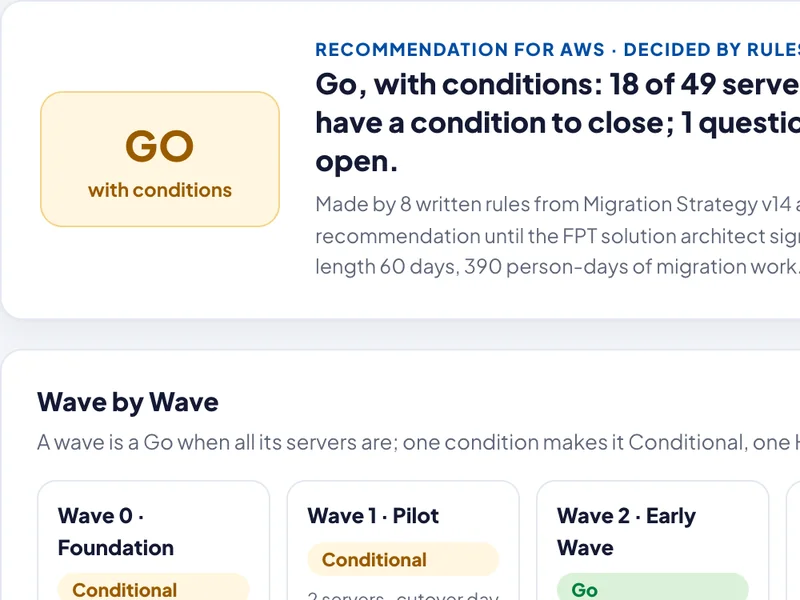
Customers never log in to FleziLift, and it moves nothing. The migration runs on AWS, Azure and Google Cloud tooling.
Who does what in a migration
People decide, the providers' tools move the data, and FleziLift speeds up the reading and drafting in between.
- Interview app owners; agree scope
- Check the inventory with the business
- AWS Application Discovery Service, Migration Hub
- Azure Migrate appliance
- CMDB and RVTools exports
- One inventory, each value cited and graded L0–L3
- Gaps become 15 ranked questions
- Three independent readings, majority vote
- Architect signs the 7R path
- Overrides need a written reason
- TCO data from AWS Migration Evaluator and discovery tools
- Applies the written 7R rule tree
- Risk as probability × impact
- Wave order, freeze windows, owners
- A client captain per stream
- Dependency maps from discovery data
- Move groups from real dependencies
- Pilot up to 5 servers; early waves 10, later 15
- Person-day estimate per work package
- Parallel five-person streams, one runbook
- Functional, network and performance tests
- Servers: Application Migration Service, Azure Migrate, Migrate to Virtual Machines
- Databases: AWS DMS and SCT, Azure DMS, Google Cloud DMS
- Files: AWS DataSync
- No role: the providers' tools move the data
- Architecture and security review
- Go-live on a green flag; rollback agreed
- Monitoring and automated tests on the target
- 8 Go/No-Go rules and 7 dated gates, T−28 to T+3
- Two weeks of close watch with owners
- Handover to operations
- Dashboards and alerts for the new estate
- Playbook and handover pack drafted for review